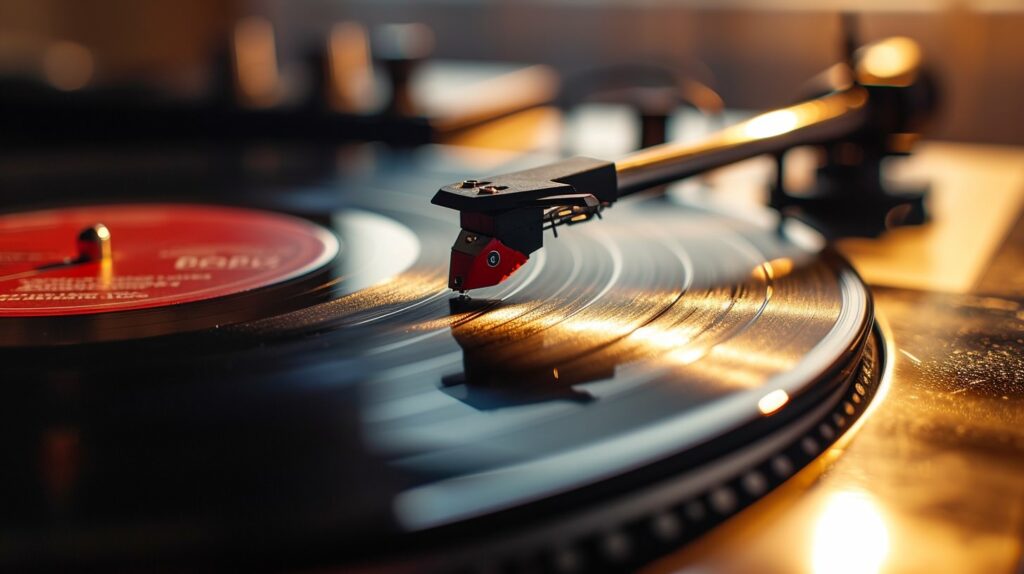
There’s something almost magical about dropping the needle on a vinyl record and hearing music come to life. Unlike digital streaming or CDs, vinyl has a warmth and depth that music lovers swear by.
But how does a simple spinning disc produce such rich sound? The answer lies in grooves, vibrations, and a bit of fascinating physics.
Let’s take a deep dive into how vinyl records work and learn about this wonderful technology!
The Basics of Vinyl Records
A vinyl record is essentially a physical storage medium for sound. It’s a flat, circular disc made of polyvinyl chloride (PVC) with tiny, spiral grooves cut into its surface. These grooves contain an analog representation of sound waves.
When a turntable’s needle (stylus) moves through the grooves, it vibrates, and those vibrations are converted into electrical signals. These signals are then amplified and turned into the music we hear through speakers or headphones.

The Role of the Groove
If you look closely at a vinyl record under a microscope, you’d see that the groove isn’t just a smooth spiral—it’s actually full of tiny bumps and valleys. These physical patterns encode the original sound waves.
When the record spins, the stylus follows the groove and moves up and down (vertically) and side to side (laterally). These movements correspond to the original recorded sounds.
Older records used only lateral movement, which is why early phonographs had a more limited range of sound. But modern vinyl uses a combination of vertical and lateral movement to capture more detail—this is called “stereo” sound, allowing for different sounds in the left and right speakers.
How the Stylus and Cartridge Work
The stylus, or needle, is the small pointed tip that physically contacts the record. It’s usually made from diamond or sapphire to withstand the constant friction of playing records.
As the stylus moves, it sends vibrations into the cartridge, a small device attached to the tonearm of the turntable.
Inside the cartridge, there are tiny coils and magnets (in a moving magnet cartridge) or coils and a tiny moving piece of metal (in a moving coil cartridge). These components work together to convert the vibrations into electrical signals.
Turning Vibrations Into Sound
Once the cartridge generates an electrical signal, it travels through the turntable’s wiring to a preamplifier. This preamp boosts the weak signal before sending it to the amplifier, which makes it powerful enough to drive speakers. The speakers then convert the electrical energy back into sound waves, recreating the original music.
Why Vinyl Sounds Unique
Many people believe vinyl records have a “warmer” or more “natural” sound compared to digital formats. This is because vinyl is an analog medium, meaning the sound waves are stored in a continuous, physical format rather than being chopped up into digital bits like CDs or MP3s.
This analog nature captures more subtle variations in sound, preserving details that can sometimes be lost in digital compression.
Another factor is the way vinyl interacts with the equipment used to play it. The stylus physically touches the record, meaning minor imperfections, dust, and wear can affect the sound.
Some listeners enjoy these little quirks—like the occasional crackle or pop—as part of vinyl’s charm.
The Science Behind the Spin
Records come in different sizes and speeds, typically 33 1/3 RPM (revolutions per minute) for LPs (long-playing records) and 45 RPM for singles.
The speed at which a record spins determines how much music can fit on each side. Faster speeds allow for better sound quality, but slower speeds allow for more music to be stored.
The turntable itself plays a crucial role in how well the record plays. A high-quality turntable minimizes vibrations and maintains a steady speed, preventing unwanted distortions.
Belt-driven turntables reduce motor noise, while direct-drive turntables offer better speed stability, making them popular among DJs.
A Timeless Technology
Despite being over a century old, vinyl records continue to thrive, even in the age of digital music. Audiophiles, collectors, and casual listeners alike appreciate the tactile experience of handling records, reading album artwork, and carefully placing the needle to play a favorite track.
The technology may be simple—just grooves, vibrations, and amplification—but the result is a sound that has stood the test of time.